One premise in, a session you can run out
Tabletop game prep, laid out the way you use it at the table.
A game master with a full week has two hours on a Thursday and a table on Saturday. The half of prep that gets dropped is the unglamorous half: statting the fight so it's dangerous instead of lethal, writing down what the innkeeper wants, and deciding what happens when the party ignores every hook you wrote.
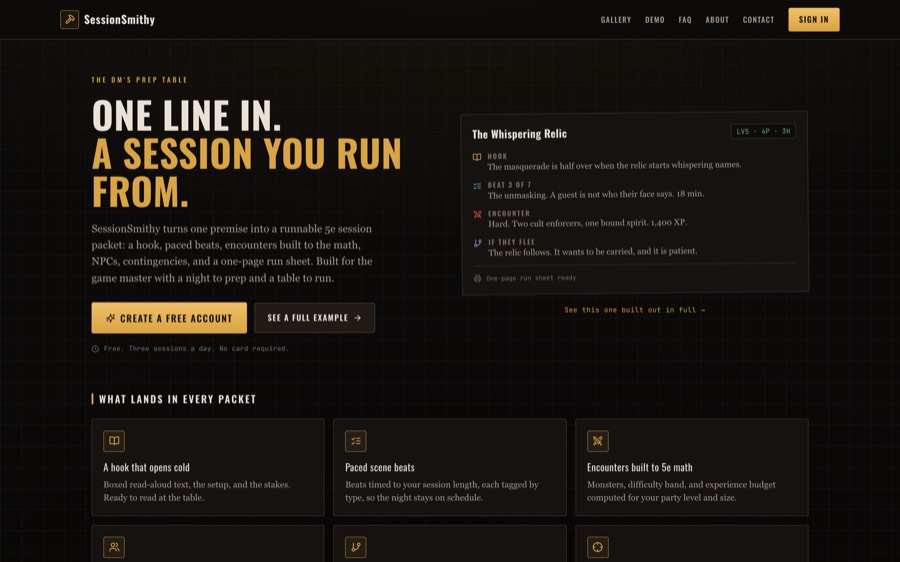
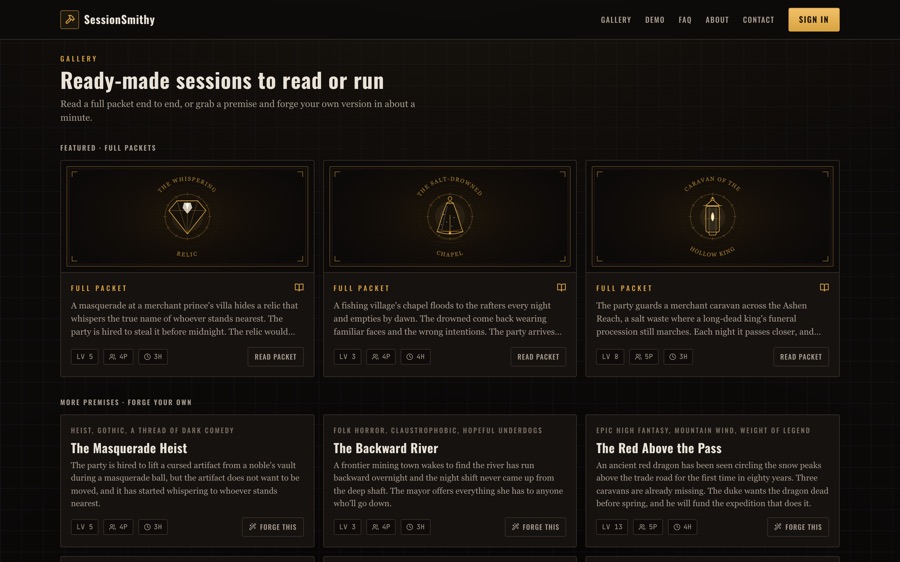
SessionSmithy takes a line of premise and returns a packet: a hook, paced scene beats, encounters built to 5e math, NPC quick references, contingencies for what the party does instead, and a one-page run sheet. A gallery of finished packets is readable without an account, so you can see the output before you make one.
Open SessionSmithy.comThe App
The gallery and the sample packets are open to anyone.
Seven Beats Paced to Three Hours
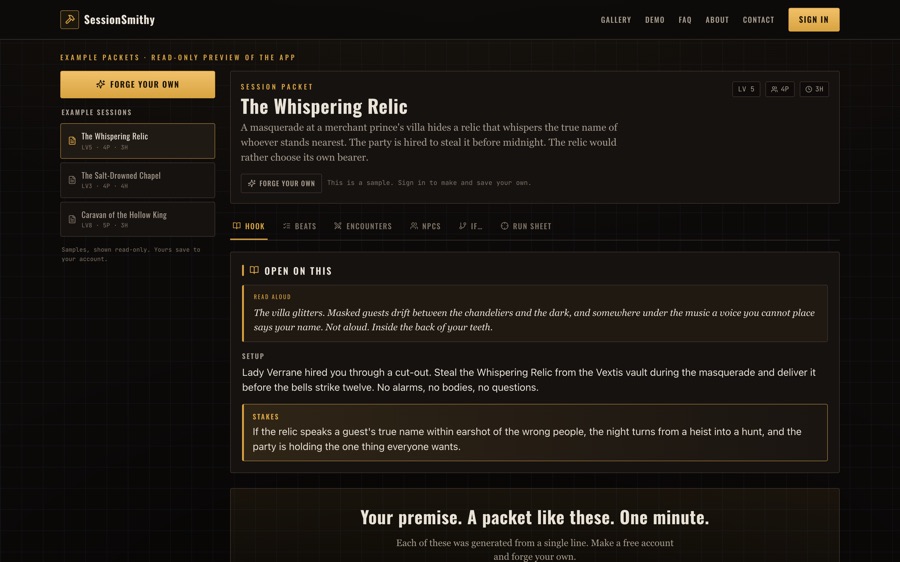
This is the sample packet on the site, set for four players at level 5 and a three-hour session. Every beat carries its own time, and the two fights carry their difficulty and XP.
The Whispering Relic, 7 beats, 2 hr 40 min of a 3 hr session
-
Through the front door
-
The wrong wing
-
The riddle-lock
-
Interruption at the vault
Fight: Hard, about 1,400 XP
-
The relic speaks
-
The unmasking
-
The bells
Fight: Deadly, about 2,200 XP
Run Mode Is the Half That Gets Used at the Table
A prep document is something you read on Thursday. On Saturday night you need something else: big type, one beat in front of you at a time, and a way to tell whether you're running long before the players notice.
Run mode is a full-screen view of the same packet. Every beat carries its own stopwatch, and the running total sits against the session length you asked for and turns red once you pass it. The initiative tracker seeds itself from the party size and that encounter's monsters, with hit points you tap down as the fight goes. It writes nothing back into the packet, so nothing that happens at the table edits the prep.
One rule holds the whole thing together: the model writes, and the code does the arithmetic. A "harder" nudge steers the prose. It doesn't touch the numbers, because the difficulty band and the XP are recomputed every time the packet is opened.
What It Does
What comes out
- A hook that gives the party a reason to be in the room
- Scene beats with a time budget, so the session fits the evening you have
- Encounters built to 5e math, with the difficulty band and the XP computed in code
- NPC quick references, and contingencies for what the party does instead
- A one-page run sheet, printable, or a PDF in one click
What you can change in a session
- Regenerate any single section without disturbing the rest of the packet
- Five nudges per section: harder, easier, shorter, longer, grittier
- Edit anything afterward, including find and replace across the whole packet
- Share a read-only link with the people at your table
- A free account gets three sessions a day, which is the plan rather than a trial
SessionSmithy isn't affiliated with, endorsed, sponsored or approved by Wizards of the Coast LLC.
Tell Us What Your Business Does by Hand
This one exists because most game prep turned out to be bookkeeping, and a lot of business work is the same.
Based in St. Clair Shores, working across Metro Detroit.
The Rest of the Work
- Pathway to Self Tarot and oracle readings, Reiki and life coaching, online over Zoom or in person at GVST Wellness.
- Advertising and Graphics A Metro Detroit shop that makes signs, vehicle wraps, print, apparel and promotional products, on a site where every photo shows work the shop delivered.
- The Referral Exchange A Clawson referral group of 26 businesses, one seat per trade, meeting Wednesday mornings at Thrive Rehabilitation.
- GVST Wellness A yoga and group fitness studio in St. Clair Shores and Harrison Township, moved off a template onto a site of its own.
- WeeklyAsk A directory, this week's asks, the referral log, attendance and dues, in one place instead of five.
- PokerThangs A trainer for live low-stakes poker, where you get a messy pot, an uncounted stack and no time to work either of them out.